Benin Plaque
Benin Plaques are very popular in African art and culture. The purpose of these plaques was to display how the Benin people viewed themselves, specifically to Portuguese traders and their soldiers. The people of Benin perceived them to have thin faces, bearded, strange attire, and pointed noses. These plaques would be placed throughout the king’s palace to show how the Portuguese were seen as symbols of the king’s power and wealth. The Benin people wanted to make a good impression on the Portuguese because they contributed to their trade a lot.
Besides displaying people, animals had a lot of symbolism in the plaques as well. One of the most significant animals to be displayed on the Benin plaques is a leopard. The purpose of having leopards in art is to show how the king also has power over the tropical forest. The forest is covered in most of Benin, which is very important because it just makes the king that more mighty. The leopard symbolizes the king of the forest, while the Oba is the king of the city and the villages of his people of Benin. Since the forest is in Benin, the Oba rules the forest and city. The plaques would display the king with leopards. This is because the king would have the leopards captured as a sense of power and also used them as sacrifice. The animals are more than just meaning, they have a great significance in Benin art. This specific Benin plaque displays the Oba posing with leopards. It was made around the 16th and 17th century. The plaque is made of brass and is 49 centimeters, by 34 centimeters, by 6 centimeters. The Oba has different attire on; he has bead ornaments fringed with bells. The king’s legs are visible with fish hanging on his sides. The king’s arms are in the air with both hands holding leopards. The leopards are wearing collars with small hawk-bells. This usually means that the leopards are tamed.
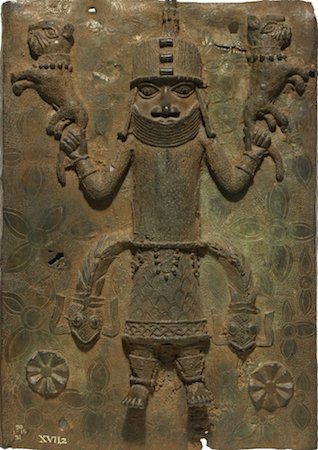
Unlike this plaque, other plaques displayed
the Oba with his attendants. The purpose of displaying other people with the
king was to represent ceremonies. There was a large amount of people that would
have different parts in doing ritual pageantry. People would represent chiefs,
crafts guilds, representatives of local communities, and officials.
https://africa.uima.uiowa.edu/media/photos/show/2539?back=chapters%2Fancient-africa


Comments
Post a Comment