Sutton Hoo ship burial purse clasps
Artifacts from Sutton Hoo were found in a burial site. The burial is thought to have been from very important person. The amount of wealth from burial means the artifacts came from a royal burial. It is believed that it could have been king Raedwald. England at this time was divided into a series of kingdoms, so it is hard to determine if this is definite or not. Beautiful gold, garnet and glass artifacts found in burial from early 7th century. This time period is considered the Anglo-Saxon period. Anglo-Saxon refers to this period between roman rule and the Norman invasion in 1066. The word Anglo-Saxon comes from the Anglos and the Saxons, which were people who migrated to Great Britain in the 6th century. This area is now known as northern Germany and southern Denmark. All of these artifacts were found at Sutton Hoo in ancient kingdom of East Anglia.
Archaeologists found imprint of a large ship that had actually been used and hulled up from an estuary near by for important ceremonial burial. However, there was no trace of body or the ship remains. This is most likely because of the acidic soil. Fortunately, the gold did remain.
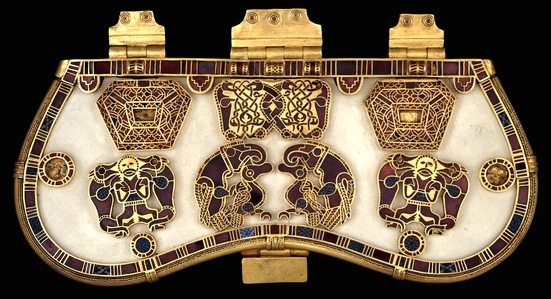
https://www.khanacademy.org/humanities/medieval-world/early-medieval-art/early-medieval-objects/a/the-sutton-hoo-purse-lid#:~:text=Purse%20lid%20from%20the%20Sutton%20Hoo%20ship%20burial&text=The%20lid%20was%20made%20to,in%20early%20Anglo%2DSaxon%20England.
The two most famous pieces that
were found from this burial was a purse lid and two shoulder clasps. The purse
lid is made with gold and garnet, with possible walrus ivory as a base if the
detailed designs. The designs are so intricate. They are put into patterns
through out the lid and resemble abstract figures of animals and people. This
includes abstract interlacing and human figures and of animal figures. The inlaced
technique inlaces the garnet and glass into one another. There is also another
technique called Milliefiori. This Italian word means a thousand flowers. This technique
is when decorative glassware in which colored glass
rods are fused and cut to create patterns. Canes of glass are gathered, fused and sliced. Artists
take canes of glass and bundle them together, warm them so they fuse, and you
can slice them into thin patterned fields. Also used cloisonné technique; which
uses gold strands to enclose glass or garnet
The gorgeous purse lid is now on display at London museum
with shoulder clasps. The two artifacts are usually conjoined by belt buckle
that is being borrowed at another museum right now


Comments
Post a Comment